
Marblehead City Directory Runs
Marblehead’s historical directories are held in several collections, each with its own gaps and access rules. The Marblehead Museum, Massachusetts State Library, Salem Public Library, and Abbot Public Library preserve overlapping parts of the record. That overlap matters. A missing year in one Marblehead collection may survive in a Salem-area book or a library database. Treat a directory as a dated snapshot of an address, a business, or a listed person, then confirm its meaning with another source.
| Collection | Years | Where held | Access |
|---|---|---|---|
| Marblehead Museum directory runs | 1873, 1877, 1884, 1895-96, 1913-22, 1919, 1936-46 | Marblehead Museum and linked library collections | Scans for selected runs; later runs may require HeritageQuest or Ancestry access |
| State Library Marblehead holdings | 1873-1980, in irregular runs | Massachusetts State Library holdings list | Holdings reference and library research route |
| Salem-area combined directories | 1881 onward in listed runs | Salem Public Library | Digitized PDFs with separate Marblehead sections |
| Marblehead Messenger and Reporter archive | 1871-1976 online; later Reporter and clipping material continues | Abbot Library archive and Marblehead Room | Free online early run; later material is generally library-only |
The Marblehead Museum directory collection identifies early regional and North Shore volumes, while the State Library holdings list supplies a broader chronological check. No source supports treating these Marblehead holdings as a complete annual run. Gaps are part of the evidence, not proof that a person left town.
Access also changes from one run to another. The Museum identifies scanned editions and later subscription-library paths. Salem Public Library supplies combined regional volumes with Marblehead material inside the scan. Abbot Library supplies local assistance, the Marblehead Room, and an archive route for newspapers that can bridge a missed directory year. When a digital copy is incomplete or unavailable, note the exact desired edition and ask the holding library whether it is available in person, through HeritageQuest or Ancestry access, or by a reference request. That preserves the original edition rather than replacing it with a later summary.
Marblehead City Directory Years
The State Library records Marblehead directory holdings beginning in 1873 and extending through 1980, but the sequence is not continuous. Its list includes long stretches from 1905 through 1918 and 1929 through 1937, followed by selected postwar volumes. Museum resources add 1877, 1884, the 1895-96 Naumkeag Directory, North Shore volumes from 1913 through 1922, and later 1919 and 1936-46 access paths. Check the exact edition rather than filling a gap with a nearby date.
- 1873 marks the first Marblehead year identified in the State Library holdings.
- 1895-96 appears in the Marblehead Museum’s Naumkeag Directory material.
- 1913-22 is represented by North Shore “Who’s Who” volumes, with gaps.
- 1929-37 is one of the longer State Library sequences.
- 1980 is the latest Marblehead directory year identified in the holdings list.
These dates describe collection coverage, not a promise that every page is digitized. A librarian, the Museum, or the State Library can help identify the next physical or subscription route when an appropriate Marblehead scan is absent.
Note: Record the edition year and page image before comparing a Marblehead entry with a later source.
Salem Volumes, Marblehead Sections
A book titled for Salem can still be a Marblehead historical source. The combined Salem-area volumes separate name, street or householder, business, government, neighboring-town, and advertisement sections. Find a surname first, then inspect the Marblehead street listing and the business pages. The two sections may place the same address in a different context, which is useful when initials or abbreviated street names make an alphabetical search uncertain.
The Salem Public Library city-directory collection shows the regional runs and their Marblehead coverage.
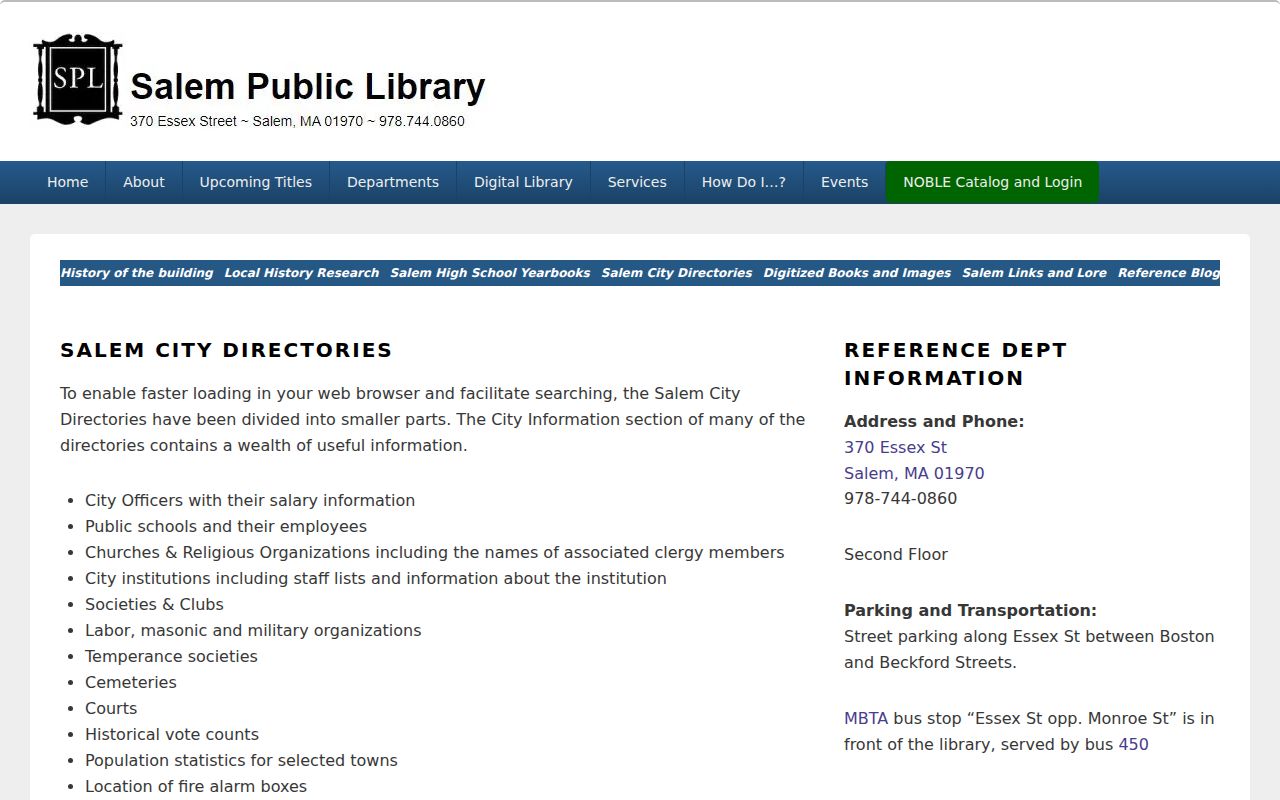
The library screen is a helpful reminder to open the Marblehead portion of a combined scan rather than dismissing it by the volume title. Those sections can also identify local civic institutions and businesses alongside household entries.
Marblehead Room Directory Shelf
The Marblehead Room at Abbot Public Library is the local fallback when a run is not freely viewable online. Its holdings include local histories, maps, atlases, town reports, vital records, yearbooks, genealogies, newspapers, clipping files, and pamphlets. Those materials make a sparse directory line more useful. A street address can be checked against a map; a last appearance can be checked in a notice; a yearbook can separate two people with the same name.
The Abbot Library’s collection information distinguishes material that can be consulted locally from material that circulates. The free digital archive covers the Marblehead Messenger and Reporter from 1871 through 1976. Reporter issues from 1977 onward and the clipping file from 1900 onward are generally available inside the library because of copyright limits. Confirm current hours before visiting.
Reading Marblehead City Entries
A Marblehead directory entry usually supplies a surname, given name or initials, address, and often an occupation or business description. The exact arrangement changes by publisher and year. The inspected historical samples support those core fields, as well as section headings that divide alphabetical names from streets, businesses, government, and nearby towns. Read the abbreviation key in the same volume before expanding an initial or interpreting a short street form.
| Name form | Surname plus given name or initials, as printed in that edition. |
|---|---|
| Address | Street and house reference in a name or street/householder section. |
| Occupation or business | A role, enterprise, or institutional description when the run supplies one. |
| Section heading | Alphabetical, street/householder, business, government, or neighboring-town placement. |
| Abbreviation key | The edition’s own guide to abbreviated terms and address styling. |
- Criss-cross directory
- A directory arranged by street and address so a researcher can begin with a location rather than a name.
- Householder index
- The street-order portion that groups listed names or occupants under an address.
- Abbreviation key
- The publisher’s explanation of short forms used in its listings; it can vary from one Marblehead volume to another.
Spouse notation, ownership marks, telephone details, and reverse fields were not verified in every captured Marblehead sample. Do not assume that a missing field means it was never recorded, or that it appears in every edition.
Marblehead City Directory Paths
Use the two main directory paths together. The alphabetical listing starts with a person or family name. The street or householder listing starts with a location and can reveal a different ordering of the same material. A search that begins with an address should move from the street section to the name section, then to the business or government pages when the address appears to be commercial or civic.
For an older Marblehead directory, try surname variants, initials, married or widow names, shortened street forms, and the surrounding addresses. Nineteenth-century volumes often compress names and occupations. A directory record can describe a resident, an institution, a business occupant, or a voter. It does not by itself establish a modern connection to that address.
A historical street question can continue through the modern address records on the Marblehead By Street directory, where assessment and deed tools serve a different purpose.
Tracing Marblehead City Households
Build a small comparison table as a household moves through Marblehead directories. Keep the exact name form, address, occupation or business wording, co-listed names, edition year, and page image. Then place a directory before and after a federal census year. The public federal census schedule through 1950 offers household-wide context, while a directory offers a more frequent, address-focused observation. Together they reduce same-name mistakes.
- Locate the earliest likely Marblehead listing and save its page image.
- Check the next available local edition, not merely the next decade.
- Compare the alphabetical entry with the street or householder section.
- Pair the surrounding editions with the appropriate federal census household.
- Use a newspaper notice, cemetery record, vital record, or probate file to test a final appearance.
A disappearance can reflect a move, a death, a changed name, a skipped edition, or a source rule. It deserves a second record, not a quick conclusion. If a historical find needs a current official cross-check, use the focused workflow in the Marblehead resident lookup.
Note: A matching address, date, and second record are stronger than a name match alone.
Newspapers Between Marblehead Directories
Newspapers bridge years where no Marblehead directory is available. The digitized Messenger and Reporter archive is free for 1871-1976. A surname, address, old business name, or street can uncover an obituary, school item, advertisement, civic notice, or property story that fixes an entry in time. The later Reporter and clipping collection remains a library research channel, not an unrestricted web archive.
The digitized Marblehead newspaper archive supports text and date searching. Use its result to return to a directory year, not to replace the directory’s printed address or name form. Newspapers often add the personal or organizational detail that a compact listing leaves out.
Marblehead Directory History Clues
The Marblehead Historical Commission catalog has more than 15,000 PastPerfect entries across objects, photographs, archives, and library material.
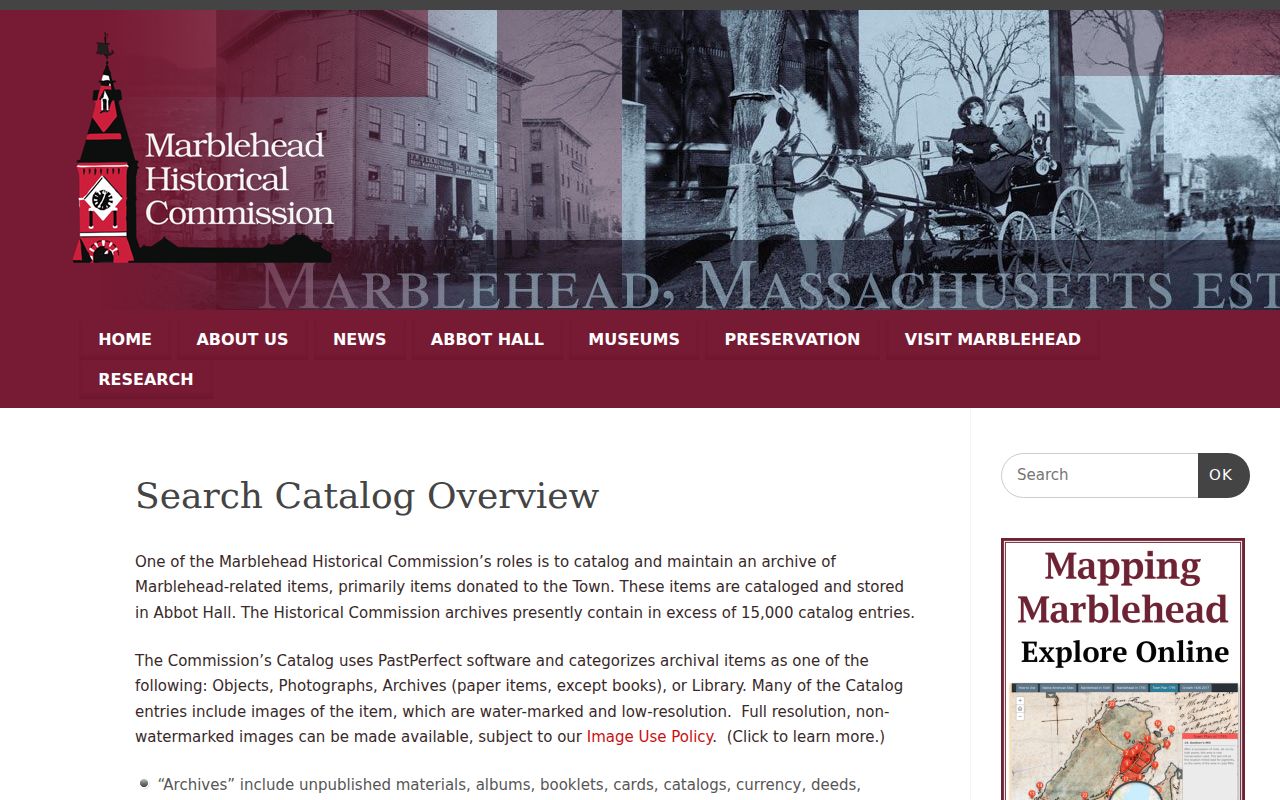
Its archive and library categories can supply maps, deeds, newspapers, yearbooks, photographs, and organizational papers that clarify a thin city-directory line. Online images are generally low resolution, and higher-resolution use follows the Commission’s terms.
Marblehead’s directories also preserve the town’s changing commercial story. An 1856 map listed 22 shoe manufacturers, including a dense pattern on Pleasant, Washington, and Sewall Streets. A directory business name from those streets can be checked against a Sanborn map, a Messenger advertisement, and later Registry material. This makes the 1873-1980 directory span more than a name list: it is a practical cross-index for a town with layered maritime, industrial, and neighborhood history.